On this page
- What does the night movement ban cover?
- Which waters are named?
- How does it change a Padar sunrise?
- Can three-day trips still run?
- Why did the rule come in?
- What else decides the route once the rule is met?
- What do readers ask about routing and the ban?
- Which sources support this page?
- How do I reach the desk?
By Luxury Phinisi Labuan Bajo Editorial Desk
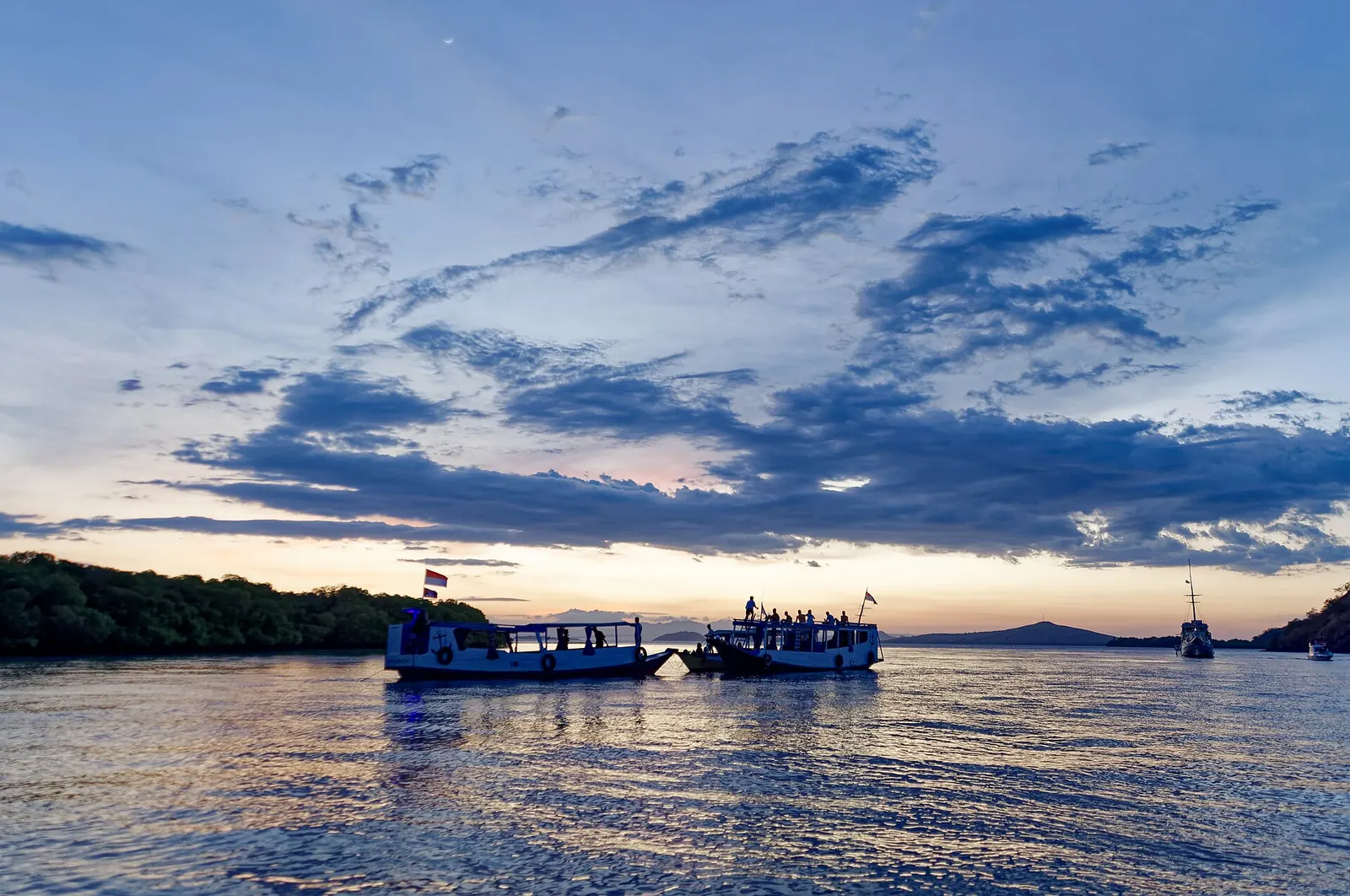
The exact route depends first on where a boat may be after dark. Antara reported in January 2026 that the Labuan Bajo harbourmaster barred night movement in park waters, especially at risk points such as the Padar Strait. Weather, tides and currents then shape each day, and at least one operator gives its captain the final word.
What does the night movement ban cover?
Antara's report of 9 January 2026 says the Labuan Bajo harbourmaster, known by the Indonesian abbreviation KSOP, barred boat movement at night in the waters of Komodo National Park. It singles out risk points such as the Padar Strait, and it says three-day two-night trips can still run.
That is the extent of what we can state from the report. We have not found the text of the notice itself, so we cannot tell you how it defines night, whether any class of vessel is treated differently, or what sanction applies. Ask your operator what the boat's own departure and arrival limits are. A concrete answer in hours tells you more than a general assurance that the boat follows the rules.
Keep this separate from a sailing closure, which is a different kind of stop. CNN Indonesia reported a KSOP notice closing clearance for all tourist boats from 12 to 15 January 2026, or until the weather agency reported better conditions. An operator guide says that January stop held for roughly a month in practice. A closure stops the trip. The night ban leaves the trip running and changes its shape. Our page on what happens when the weather turns deals with closures.
Which waters are named?
The two sources differ in how far they go. Antara gives the Padar Strait as its example. A Komodo operator guide offers a longer list of hazard areas:
- Kelor
- Batu Tiga
- Molo Strait
- Padar Strait
- Loh Kima
- Luwu
- Kerangga
- Mauwang
- Tatawa
- Siaba Kecil
That list is the guide's own, so do not treat it as a legal map. Its practical use is as a set of names to look for in an itinerary. If a plan shows a late-afternoon leg through or past one of these places, ask how much daylight the boat has in hand. Some of them share or echo the names of popular stops, so a route that looks relaxed on a brochure may have little margin on the water.
How does it change a Padar sunrise?
The sunrise survives, but the sequence behind it changes. The operator guide says older itineraries that crossed to Padar overnight for sunrise no longer work, and that the boat must anchor near Padar before sunset the evening before. The table turns that into lines you may meet in an itinerary. The readings are ours, not the wording of the notice.
| Line in an itinerary | How to read it now |
|---|---|
| Dinner at one anchorage, wake up at Padar | The guide says this no longer works. Ask where the boat actually sleeps. |
| Anchor near Padar on the first evening, climb at first light | This matches what the guide describes. Check what time the boat must leave the stop before it. |
| Dusk stop, then on to the next island | Ask whether the move happens before dark. If not, the night anchorage has to be close to the dusk stop. |
| Evening return to Labuan Bajo on the last day | Ask for the planned arrival time, and what happens if the boat runs late. |
The effect falls hardest on the day before the sunrise, which now has a fixed end. Any stop planned for that afternoon has to finish early enough to reach the anchorage in daylight. On a longer charter you can spread this out across the week. On a short one it may decide the whole plan.
Can three-day trips still run?
Yes. Antara says so directly, and the operator guide still publishes a three-day sample alongside its anchoring advice. What has gone is the assumption that a short trip can recover lost distance overnight. Time lost to a slow morning stays lost. Our labelled sample of three days and two nights shows how the evenings set the route.
Why did the rule come in?
The operator guide connects it to the sinking of KM Putri Sakinah in the Padar Strait on the night of 26 December 2025. It reports that seven people were rescued and four died, and that the night ban and three-monthly inspections followed. Detik separately reports inspection and testing of Labuan Bajo tourist boats every three months. The causal link is the guide's account. We have not found the harbourmaster's own statement of reasons.
The water itself explains why a strait at night is taken seriously. Wikipedia warns of currents on the eastern side of Komodo, running towards Labuan Bajo, that can turn extremely dangerous under inexperienced guides. A vessel's equipment is a separate matter from its route, and our page on what to check on board covers it.
What else decides the route once the rule is met?
Inside the daylight limit, conditions and command take over. Vela says its Captain and Cruise Director have the final word on all activities on board and that itineraries may change at short notice for weather, tides or currents. That is one boat's published position, but it is worth asking any operator for the same wording, since it tells you who decides when you and the crew disagree.
Clearance sits above that. Detik quotes the KSOP head saying a sailing clearance rests on two indicators, the vessel's seaworthiness and the weather. Then come the boat's range and your own priorities. A Komodo operator lists range among the four things you pay for at the top end, which matters if your plan reaches beyond the central park. Guest interests come last, because they can only rearrange what the first three allow.
What do readers ask about routing and the ban?
Can I ask the captain to move the boat at night for an earlier start?
No, not as the ban is reported. Antara describes a bar on night movement in park waters, and we have not found a published exemption for charter guests. Ask for an anchorage closer to your morning stop.
What are the rules for route changes during a cruise?
That varies by operator. Vela gives the final word to its Captain and Cruise Director and warns of short-notice changes. Ask your operator for its wording, and whether a change affects the price.
How does tide influence the route?
Tide and current affect which leg is sensible at which hour, and Vela names both as reasons an itinerary may change. The decision on which leg runs when rests with the crew on the day.
Do anchorage rules affect what a boat can do in the evening?
Yes. If a boat has to be at its anchorage before dark, a dusk stop limits where it can sleep. A written plan should show both the stops and the night anchorages.
Does a boat's range or our interests change the route?
Yes, but within limits. A boat with longer range can plan further, and your group's priorities can reorder the day, but neither overrides the night ban, the sailing clearance or the captain's call on conditions.
Which sources support this page?
- Antara on the Labuan Bajo night movement ban, 9 January 2026
- Komodo operator guide on yacht charters (komodoresort.com)
- Operator guide on the January 2026 stop (komodoresort.com)
- CNN Indonesia on KSOP notice 05/MP-I/2026
- Detik on sailing clearance and inspections, 10 February 2026
- Wikipedia on Komodo National Park
- Vela FAQ (sailvela.com)
- Komodo operator page on luxury boats (komodoresort.com)
How do I reach the desk?
Have an itinerary you want read against the night rule? Paste the day lines into a message to WhatsApp 6281139414563 or an email to bd@juaraholding.com. The desk points out what the sources say; the party named in your offer answers for the route.
Send the desk your dates, group size, and budget range. The desk replies in writing.
Ask the desk on WhatsApp bd@juaraholding.com